AI is already widely used across organizations, helping employees work faster and achieve substantial productivity gains. Our approach takes the next step by focusing on the decision making process. We use AI to help managers and teams understand the situation, evaluate options and decide what to do and how to do it. Success is measured through business outcomes.
Augmented Decision Making
Augmented decision making means using AI alongside business data, knowledge and experience to improve individual and team decisions. Each decision point determines what action to take and who will carry it out: a person, AI or a combination of both. AI can advise people, make delegated decisions, or take action within agreed limits. Our approach helps organizations move from individual AI use to reliable, secure enterprise adoption, focused on making the right business decisions.
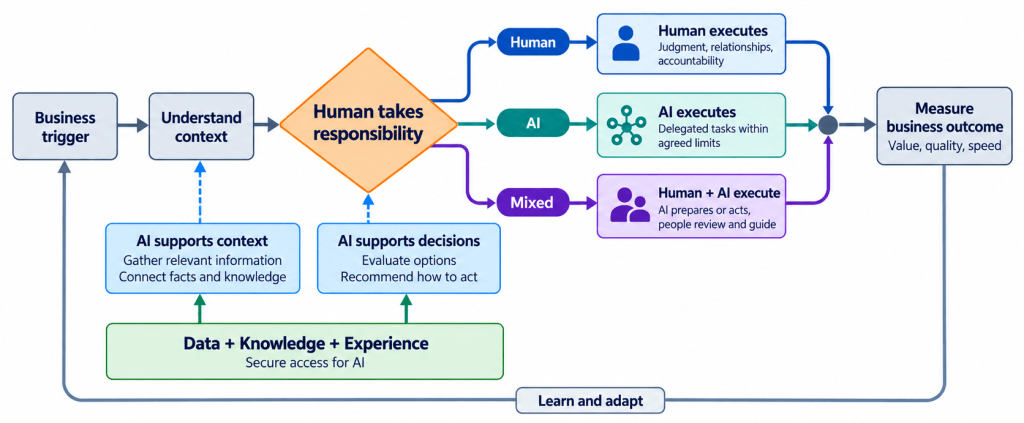
Example: A manager decides how much budget to allocate to each department or project. AI brings together historical spending and performance with input from team leaders. It forecasts future needs, analyzes opportunities and risks, and proposes allocation scenarios with clear assumptions and expected results. The manager compares the scenarios, applies business judgment and takes responsibility for the final allocation. Actual spending and business results are then compared with the plan by AI and deviations are signaled to manager.
Five practical steps
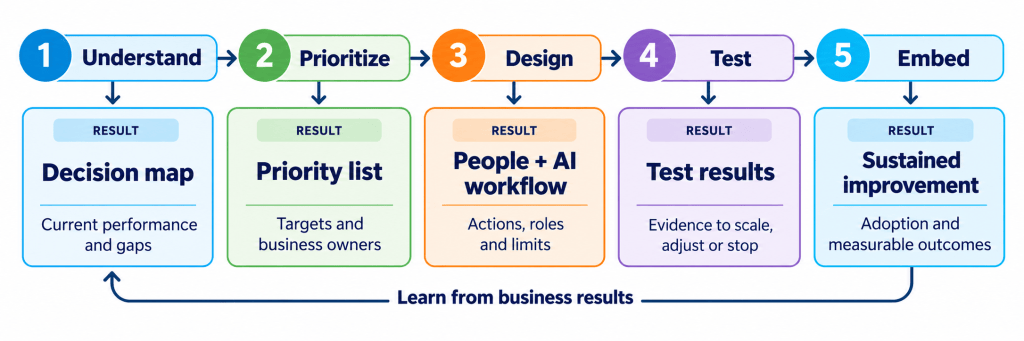
1 Understand current decisions
Map the key decision points in a business process. Identify who decides, what information they use, who carries out the action and how the outcome is measured. Record current cost, time and quality as the starting point for comparison.
Result: A clear picture of current decisions, gaps and performance.
2 Choose priorities and define success
Select the decisions where improvement could create the most business value and is practical to deliver. Set measurable targets, such as shorter response times or fewer errors, and name a business owner responsible for the results.
Result: A short list of opportunities with clear targets and owners.
3 Design how people and AI will work together
Decide how AI will use business data, knowledge and experience to support each decision. Define the action and who will carry it out: a person, AI or both. Set the limits for AI decisions and actions, and make responsibility clear.
Result: A practical way of working with clear roles and limits.
4 Test on a small scale
Try the new approach with real users and business cases. Compare the results with the starting point and agreed targets, including the cost of using AI. Use evidence and feedback to decide whether to expand, improve or stop.
Result: Evidence of business value and a clear next step.
5 Make it part of everyday work
Expand successful changes into everyday operations. Train people, connect the AI tools to existing systems and give AI secure access to the information it needs. Keep measuring business results and use lessons learned to improve decisions and actions.
Result: Sustained use, clear ownership and measurable improvement.

