Decision-makers are not short of information. They are surrounded by it. AnB Business Navigator helps each person focus on the changes, risks, opportunities and actions that matter in their own business context.
Decision-makers don’t lack information. They are overwhelmed by it.
Dashboards, reports, emails, calls, alerts, messages and documents all compete for attention. Each source may contain something useful, but the most important signal is often hidden between multiple systems and communication channels.
A manager can spend the first part of the day collecting information and still not have a clear answer to three questions: What matters today? Why does it matter? What requires action?
This is not simply a data problem. It is an attention and context problem.
THE SAME INFORMATION DOES NOT MATTER TO EVERYONE
A finance leader needs to see changing cash positions, overdue receivables and unexpected cost movements. A sales leader needs to understand pipeline risk, lost opportunities and changes in customer behaviour. An operations manager needs early warning of delays, shortages or quality issues. A chief executive needs to understand how signals across functions connect and where intervention can have the greatest impact.
Generic dashboards can show all of these figures, but they rarely determine which ones deserve attention now. More charts often mean more time spent interpreting, comparing and asking others for explanations.
AnB Business Navigator is built around the individual decision-maker: their role, responsibilities, priorities and current business situation. It helps bring forward the changes, risks, opportunities and trends that are most relevant to that context.
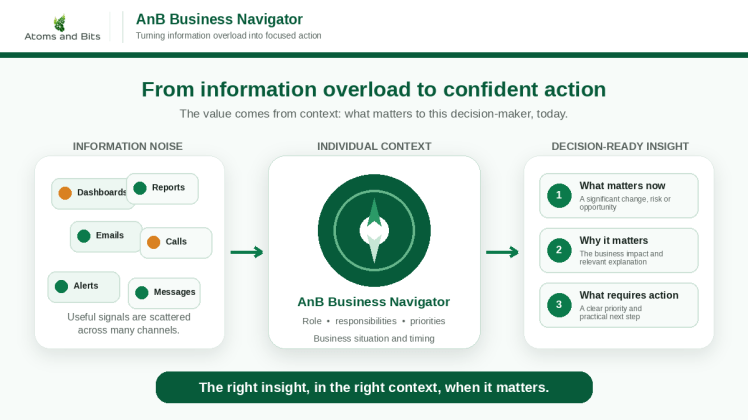
The goal is not to create another stream of notifications. It is to make the information an organisation already has more useful.
Business Navigator helps decision-makers:
- see significant changes without reviewing every report;
- understand why a change matters and what may be driving it;
- connect relevant information from business data and documents;
- identify risks and opportunities earlier; and
- focus on the questions and actions that deserve attention.
Instead of moving from screen to screen, users can start with a business question. The answer should not be a list of unrelated numbers. It should provide the relevant context, explain the potential impact and help the user decide what to examine or do next.
A PERSONAL NAVIGATOR, NOT ANOTHER GENERIC DASHBOARD
ERP, CRM, business intelligence and document systems remain essential. Business Navigator is designed to help people navigate the information they already contain and use it more effectively.
This creates a different experience for each role. A finance manager, commercial director and chief executive may look at the same business, but they should not receive the same priorities. Each person needs a focused view of what is relevant to their decisions.
The result is less time spent searching, fewer important signals missed and more time available for judgement, discussion and action.
BETTER DECISIONS BEGIN WITH BETTER FOCUS
Technology creates value when it improves the quality and timing of decisions. The advantage does not come from presenting more information. It comes from helping people notice what they might otherwise miss, understand it faster and act before a problem grows or an opportunity disappears.
That is the purpose of AnB Business Navigator: The right insight, in the right context, when it matters.
Is your management team spending more time collecting information than acting on it? Contact Atoms and Bits to discuss how AnB Business Navigator can be adapted to your roles, priorities, systems and decision processes.

